Long Range Ultraviolet Flashlight Explained: A UK Buyer's Guide
Key Takeaways
- A long range ultraviolet flashlight is designed to project usable UV intensity over greater distances, which matters for inspection work where you cannot hold the torch close to the target surface.
- For professional results, filtered 365nm UV is typically the most useful specification because it improves fluorescence visibility and reduces distracting visible purple spill.
- Beam quality, optical filtering, UV power, build quality and safety controls are more important than headline lumen-style marketing claims.
- In the UK, buyers should assess product suitability against workplace risk controls under the Health and Safety at Work etc. Act 1974 and PUWER 1998 where torches are used professionally.
- For accurate professional inspection, a torch built around a 365nm filtered black light beam will usually outperform cheaper unfiltered alternatives in real-world detection tasks.
Long Range Ultraviolet Flashlight Explained: What UK Buyers Actually Need to Know
A long range ultraviolet flashlight is not simply a standard UV torch with more power. In practice, it is a specialised inspection tool built to deliver useful ultraviolet intensity at distance, while keeping visible light contamination low enough for fluorescence to stand out clearly. That distinction matters whether you are checking industrial leaks, validating cleaning standards, tracing residues, inspecting security markings or carrying out fieldwork where getting physically close to the surface is awkward or impractical.
For many UK buyers, the confusion starts with product listings that overstate range and understate wavelength quality. “Long range” can sound impressive, but with ultraviolet equipment the better question is this: how much usable 365nm energy reaches the target, and how clean is the beam when it gets there? If the answer is poor, distance claims do not help much.
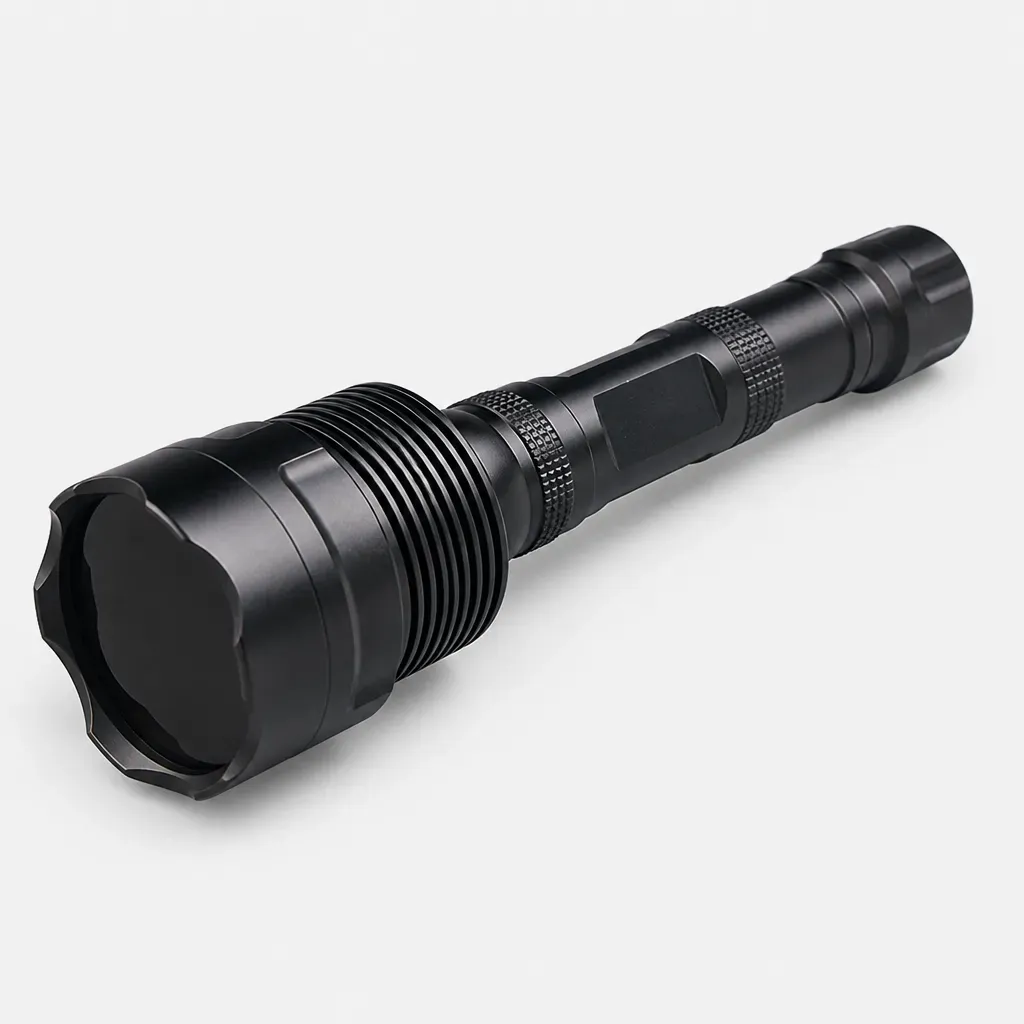
At UVBea Black, the core proposition is straightforward: a 365nm Black Light Torch for Accurate Professional Inspection. That matters because filtered 365nm UV with long-range beam power gives clearer fluorescence and less visible spill, which is precisely what serious buyers should be looking for.
What Makes a Long Range Ultraviolet Flashlight Different
The defining feature of a long range ultraviolet flashlight is its ability to maintain inspection usefulness over distance. That depends on several technical factors working together rather than one specification in isolation.
Wavelength accuracy matters more than generic “UV” labelling
Most professional handheld inspection torches are built around UVA, particularly 365nm. This wavelength is widely favoured because it excites fluorescence effectively across many dyes, residues and inspection materials while remaining practical for portable use. A cheaper torch may still be sold as UV, but if it produces a broader and more visible violet output, the target often appears washed out rather than sharply fluorescent.
Optical filtering improves contrast
A proper filter blocks much of the unwanted visible light emitted by the LED. This is critical. In real inspection work, visible purple spill can overwhelm faint fluorescence, especially across larger working distances. Filtered 365nm output gives a darker background and a cleaner signal, making contamination, traces and treated surfaces easier to read.
Beam throw is not the same as white-light throw
With a white torch, “throw” usually refers to how far the eye can see the beam. With a long range ultraviolet flashlight, you are judging how far the beam can still stimulate usable fluorescence. That makes reflector design, lens quality and UV intensity at distance more important than simplistic brightness claims.
Real range depends on the surface being inspected
Some fluorescent targets respond strongly and are visible at several metres. Others are faint and require a closer working distance even with a high-quality torch. That is why serious UK buyers should treat any advertised range as application-dependent, not absolute.
Why 365nm Is the Preferred Choice for Professional Inspection
If you are comparing products for inspection rather than novelty use, 365nm is usually the most relevant specification on the page. It is closely associated with cleaner fluorescence detection because it sits in the UVA band and can produce strong response in many inspection materials without flooding the scene with visible violet light.
This is especially important in environments where accuracy matters. Facilities teams, automotive specialists, maintenance engineers and cleaning auditors often need to distinguish weak fluorescent traces from background noise. A filtered 365nm beam can make that difference far clearer than a cheaper unfiltered alternative.
For professional users, the goal is not simply to see a purple beam. The goal is to reveal fluorescent evidence with enough contrast to make a confident decision.
That is the practical reason UVBea Black’s positioning around filtered 365nm UV with long-range beam power aligns with what experienced buyers tend to prioritise.
Where a Long Range Ultraviolet Flashlight Is Used in the UK
A long range ultraviolet flashlight has clear use cases across British commercial and specialist environments. The value comes from being able to inspect larger areas, awkward locations or elevated surfaces without compromising too much on fluorescence visibility.
Facilities, hygiene and cleaning verification
UV inspection is widely used to check the presence of fluorescent training markers, contamination traces and cleaning coverage. In healthcare-adjacent settings, surface hygiene validation methods are often part of broader compliance and infection control processes. NHS organisations regularly publish cleaning and decontamination guidance, reflecting how seriously environmental cleanliness is treated across the UK estate.
While a handheld UV torch is only one tool within a proper inspection process, better beam control and cleaner fluorescence can make audits quicker and more reliable.
Automotive and mechanical leak detection
Technicians often use UV-reactive dyes to locate leaks in air conditioning, oil and coolant systems. A long range ultraviolet flashlight is useful when engine bays are difficult to access or when the operator needs to inspect from a safer or more practical distance.
Security marking and asset identification
Security inks and forensic marking systems are common in the UK for property identification and loss prevention. A cleaner 365nm beam helps reveal markings more distinctly, which is useful for schools, offices, warehouses and event venues.
Industrial inspection and fieldwork
Warehousing, engineering and site inspection can involve large spaces, uneven lighting and restricted access. In those settings, long-range UV performance is not a luxury; it is often the difference between a usable inspection pass and wasted time repositioning repeatedly.
How to Judge Long-Range Performance Properly
Many buyers focus on battery claims or casing design first. Those points matter, but they should come after the inspection fundamentals. When assessing a long range ultraviolet flashlight, start with the characteristics that determine whether it will actually do the job.
1. Filter quality
A high-quality filter is one of the strongest indicators of a serious inspection torch. It helps suppress visible spill and improves contrast on fluorescent targets. If a beam looks overwhelmingly purple to the naked eye, that often suggests more visible contamination than ideal.
2. UV intensity at working distance
Close-range output alone is not enough. Ask how the torch performs at the distance you will genuinely use it. A unit intended for bench inspection may disappoint in a warehouse, workshop or field setting.
3. Beam shape and hotspot control
A useful long-range beam should project enough concentrated energy to reach the target while still giving workable coverage. Too narrow and you lose area efficiency. Too diffuse and fluorescence becomes weak at distance.
4. Build quality and thermal management
UV LEDs generate heat, and output stability can suffer if thermal management is poor. A robust aluminium body, sound driver design and reliable switching all matter for trade users who depend on consistent performance.
5. Battery platform and runtime consistency
For occasional use, almost any rechargeable setup may seem acceptable. For routine inspection, stable runtime and sensible charging arrangements are far more important. Output sag during a task undermines confidence in what you are seeing.
Why Cheap UV Torches Often Disappoint
The UK market is full of low-cost UV torches described as tactical, high-power or long-distance. Many are acceptable for casual novelty use, but that does not make them suitable for inspection. The common failure points are predictable.
- They use broad, poorly filtered emitters that produce too much visible violet light.
- They advertise range in vague terms without reference to actual fluorescence performance.
- They rely on inconsistent components, causing uneven output and short service life.
- They are built for price first, not inspection accuracy.
From practical experience across inspection tools, the difference between a hobby-grade torch and a professional 365nm filtered model is usually obvious within minutes of use. Better contrast means faster identification, fewer missed traces and less second-guessing.
UK Safety and Compliance Considerations
A long range ultraviolet flashlight is a useful professional tool, but it should still be treated with care. UVA exposure risk is lower than shorter-wave UV bands, yet eye safety and procedural controls still matter in workplace settings.
Relevant UK framework
Professional buyers should consider their obligations under the Health and Safety at Work etc. Act 1974 and the Provision and Use of Work Equipment Regulations 1998 (PUWER). Equipment must be suitable for intended use, maintained properly and used by trained staff where appropriate.
Practical safe-use steps
- Avoid shining UV light directly into eyes.
- Use the torch only for its intended inspection purpose.
- Assess whether protective eyewear is appropriate for the task and environment.
- Store and charge the unit in line with the manufacturer’s instructions.
- Document its use where it forms part of a formal inspection or hygiene process.
For healthcare or hygiene-related use, organisations should always align torch-based inspection methods with their internal policy, procurement standards and relevant NHS or sector guidance rather than treating the torch as a standalone compliance solution.
A Useful Data Point on Why Accuracy Matters
Environmental contamination remains a live issue in British healthcare settings. According to NHS England, there were 94,699 MRSA, MSSA, E. coli, Klebsiella spp. and Pseudomonas aeruginosa bloodstream infections reported in 2023 to 2024 across the mandatory surveillance programme categories, underlining the ongoing importance of robust hygiene and inspection processes in UK care environments.
Source: NHS England, Annual Epidemiological Commentary: Gram-negative bloodstream infections, MRSA, MSSA and C. difficile, 2023 to 2024.
That statistic does not mean a UV torch is a diagnostic device, and it should never be presented as one. It does show why inspection accuracy, cleaning verification and evidence-based environmental controls matter. Where fluorescent markers form part of a training or audit process, a better long range ultraviolet flashlight can support clearer, quicker visual assessment.
How to Choose the Right Long Range Ultraviolet Flashlight for Your Use Case
The best buying decision starts with the inspection task, not the marketing headline. Use the following checklist to narrow the field.
Choose based on inspection distance
If your work is typically within arm’s reach, almost any competent 365nm torch may be enough. If you inspect ceilings, machinery, racking, vehicle bays or larger rooms, you need stronger long-range beam performance and better optical control.
Choose based on contrast requirements
For faint residues, subtle dye traces or low-light evidence, filtered 365nm output is the safer choice. Reduced visible spill helps you detect what matters rather than the beam itself.
Choose based on environment
Workshop, warehouse and site conditions demand durable construction, reliable charging and controls that remain practical when wearing gloves or working under time pressure.
Choose based on frequency of use
An occasional user may tolerate a simpler charging routine. A professional user needs dependable runtime, consistent output and product support from a UK-facing seller.
Choose based on supplier credibility
Trust matters. Look for clear wavelength information, realistic performance claims, proper product photography, transparent support and a site that explains the inspection benefit in concrete terms. Vague language and exaggerated promises are usually warning signs.
Why UVBea Black Fits the Needs of Serious UK Buyers
UVBea Black’s core message is tightly aligned with what informed buyers actually need: 365nm Black Light Torch for Accurate Professional Inspection. That emphasis on filtered 365nm output and long-range beam power is important because it addresses the two most common barriers to usable UV inspection: poor fluorescence contrast and inadequate distance performance.
For British customers buying for professional or semi-professional work, that positioning carries practical advantages:
- Clearer fluorescence visibility for more confident inspection decisions.
- Less visible spill, which helps reduce beam washout on the target surface.
- Long-range usability for larger spaces and harder-to-reach inspection points.
- A product narrative built around accuracy rather than gimmicks.
Those are the characteristics experienced buyers tend to value most once they have used lower-grade UV torches and seen their limitations first-hand.
Shop the Right 365nm Inspection Torch
If you need a long range ultraviolet flashlight for accurate inspection in the UK, choose a torch designed around filtered 365nm UV rather than generic UV marketing. Cleaner beam quality, stronger working distance and lower visible spill make a measurable difference in real tasks.
UVBea Black offers a solution built for that purpose: filtered 365nm UV with long-range beam power for clearer fluorescence and less visible spill.
View the UVBea Black product range and choose a professional 365nm black light torch.
Frequently Asked Questions
What is the best wavelength for a long range ultraviolet flashlight?
For most professional inspection tasks, 365nm is widely regarded as the preferred choice. It delivers strong fluorescence response across many materials and, when properly filtered, produces less distracting visible spill than lower-grade alternatives.
Does a long range ultraviolet flashlight work in daylight?
It can work, but fluorescence is usually easier to see in darker conditions. Strong ambient light reduces contrast, so inspection results are generally better indoors, in shaded areas or with surrounding light reduced where practical.
Is a filtered 365nm torch better than a cheaper UV torch?
For inspection accuracy, usually yes. A filtered 365nm torch typically gives a cleaner beam, clearer fluorescence and better target contrast. That makes it more suitable for professional tasks where missed traces or uncertain results cost time.
Can UK businesses use ultraviolet torches for hygiene and inspection checks?
Yes, but they should be used within an appropriate workplace process. Businesses should assess suitability, train staff, follow manufacturer guidance and align any inspection method with relevant UK health and safety obligations and internal policy.
Ready to try UVBea Black?
Shop Now — £83.99